
Welcome to the New Brunswick Beach Report Card!
Nature NB and Birds Canada acknowledge that our work to monitor and steward at-risk birds as part of the broader Wele’k Pemjajika’q Siknikt – Côtes en santé N.-B. – Healthy Coasts NB project, takes place in Mi’kma’ki- the unceded, traditional and modern territory of the Mi’kmaq (what is now called the eastern coastline of New Brunswick). Mi’kma’ki is governed by the Peace and Friendship Treaties, which never ceded the right to land, water or resources. We recognize and support the ongoing role Mi’kmaq communities play in protecting coastal habitats, beaches, and dunes in present day as well as in time immemorial.
Beaches and coastal areas are vital places for people and wildlife. Our communities depend on beaches in many ways, such as for recreation, tourism, harvesting food, connecting with nature, and spiritual retreat. They are also homes for wildlife, including endangered Piping Plover and other species at risk (SAR).
The goal of the NB Beach Report Card is to assess the health of beaches that endangered Piping Plover and other SAR, like Bank Swallow, need for their survival.
For 41 beach sites, each report card summarizes information on threats, beachgoer stewardship and nesting Piping Plovers over a five-year period from 2020 to 2024. Surveys of sites identified as critical habitat for Piping Plover, conducted by Nature NB and Birds Canada, provide data for the report cards.
Beach report cards can be used to identify sites where conservation efforts are working and where stewardship actions may be needed. We invite you to explore results and reach out at info@naturenb.ca with questions or to get involved in our work.
Be a Coastal Guardian!
You can help Piping Plover and other wildlife on beaches by taking small, easy actions:
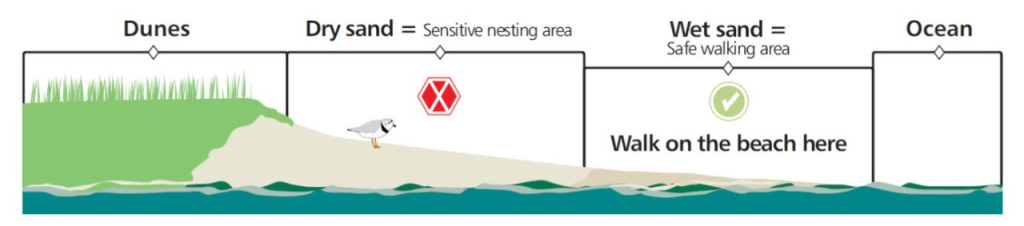
- Walk on wet sand and keep pets on leash – this helps us make sure birds and other wildlife have lots of space to rest, feed, and nest
- Leave only footprints – pick up your waste and other waste you may find at the beach
- Sign our “Act for Birds” Pledge
- Become a Coastal Guardian and volunteer to help us monitor birds, clean beaches, and more
Additional stewardship actions are shared in the beach descriptions below!
What information is presented in the beach report cards?
Each report card synthesizes five years of data collected by Nature NB and/or Birds Canada during spring and summer surveys across 41 NB beaches from 2020 to 2024. Collected data during these surveys includes various indicators of threats to bird SAR (motorized vehicle use, dogs off leash, human activity), measures of stewardship or responsible beach behaviour (proportion of dogs on a leash), and measures of shorebird presence and breeding success.
Report card indicators help us understand the health of beaches for bird SAR in these different ways:
| CategoryCatégorie | Threat IndicatorIndicateur des menaces | Can damage beach/dune habitat?Peut causer des dommages à l’habitat de plage/dune | Can disturb or harm Piping plover (adults, eggs, chicks?)Peut perturber ou nuire au pluvier siffleur (adultes, œufs, poussins?) |
|---|---|---|---|
| ThreatsMenaces | Motorized vehicle useUtilisation de véhicules motorisés | ✓ | ✓ |
| Dogs off leashChiens sans laisse | X | ✓ | |
| Beach useUtilisation de la plage | ✓ | ✓ | |
| Keeps beaches healthy and safe for wildlifeMaintient les plages saines et sûres pour la faune | Fosters stewardship among beach usersFavorise la responsabilité des usagers de la plage | ||
| StewardshipGestion Responsable | Respect for dog leashingRespect pour tenir les chiens en laisse | ✓ | ✓ |
| Volunteer involvementParticipation des bénévoles | ✓ | ✓ | |
| Community awareness activitiesActivités de sensibilisation communautaire | ✓ | ✓ | |
| Indicates suitable beach for Piping Plover / Bank SwallowIndique une plage favorable pour le Pluvier Siffleur / l’Hirondelle de Rivage | Indicates healthy, functioning beach for Piping Plover / Bank SwallowIndique une plage saine et fonctionnelle pour le Pluvier Siffleur / l’Hirondelle de Rivage | ||
| Species at RiskEspèces en péril | Piping Plover presencePrésence de Pluvier Siffleur | ✓ | X |
| Piping Plover breedingReproduction du Pluvier Siffleur | ✓ | ✓ | |
| Bank Swallow breedingReproduction des Hirondelles de Rivage | ✓ | X |
Methodology
The table below summarizes the indicators, metrics, and rankings used to assess each beach in the map below. Green colours correspond to low threats, positive stewardship actions, and positive species trends, while red colours correspond to concerning levels of threats, a lack of stewardship action, and poor species trends.
| CategoryCatégorie | Beach Activity IndicatorIndicateur des activités sur la plage | Beach Activity MetricMesure des activités sur la plage | HighÉlevé | ModerateModéré | LowFaible |
|---|---|---|---|---|---|
| ThreatsMenaces | Motorized vehicle useUtilisation de véhicules motorisés | Total vehicles and vehicle tracks per survey per kmNombre total de véhicules et de traces de véhicules par enquête et par km | ≥ 0.41 | 0.4 – 0.01 | 0 |
| Dogs off leashChiens sans laisse | Total number of dogs off leash per survey per kmNombre total de chiens sans laisse par enquête et par kilomètre | ≥ 0.41 | 0.4 – 0.01 | 0 | |
| Beach useUtilisation de la plage | Average maximum density of beach goers (people/km)Densité maximale moyenne des baigneurs (personnes/km) | ≥ 5 | 4.9 – 2 | < 2 | |
| StewardshipGestion Responsable | Respect for dog leashingRespect pour tenir les chiens en laisse | Total % of dogs on leash per surveyPourcentage total de chiens tenus en laisse par enquête | 100 | 99 – 51 | ≤ 50 |
| Volunteer involvementParticipation des bénévoles | Total number of volunteers involvedNombre total de bénévoles impliqués | > 1 | 1 | 0 | |
| Community awareness activitiesActivités de sensibilisation communautaire | Total number of unique stewardship activitiesNombre total d’activités uniques de gestion responsable | > 1 | 1 | 0 | |
| Species at RiskEspèces en péril | Piping Plover presencePrésence de Pluvier Siffleur | Average annual number of Piping Plover pairsNombre annuel moyen de couples de Pluviers Siffleurs | ≥ 1 | 0.9 – 0.2 | < 0.2 |
| Piping Plover breedingReproduction du Pluvier Siffleur | Average annual Piping Plover productivity (# fledglings/pair)Productivité annuelle moyenne du Pluvier Siffleur (nombre de poussins par couple) | ≥ 1.65 | 1.64 – 1.5 | < 1.5 | |
| Bank Swallow breedingReproduction des Hirondelles de Rivage | Average annual number of active Bank Swallow burrowsNombre annuel moyen de terriers actifs d’hirondelles de rivage | ≥ 100 | 99-11 | ≤ 10 |
The map below shows beaches of interest and includes information on stewardship actions that can be taken to improve the quality of the beach for Piping Plover and other SAR.
How to use this page
To navigate the map below and learn more about a beach of interest:
- Use your cursor to select a pin on the map
- A pop up will generate below the map where you can review information about the beach and relevant data for its report card
- If you prefer you can also scroll below the map to review sites one by one
For questions about this report or to get involved in stewardship activities on any of the presented beaches, please reach out to info@naturenb.ca or visit the Healthy Coasts NB webpage.
Frequently Asked Questions
What are Piping Plover?
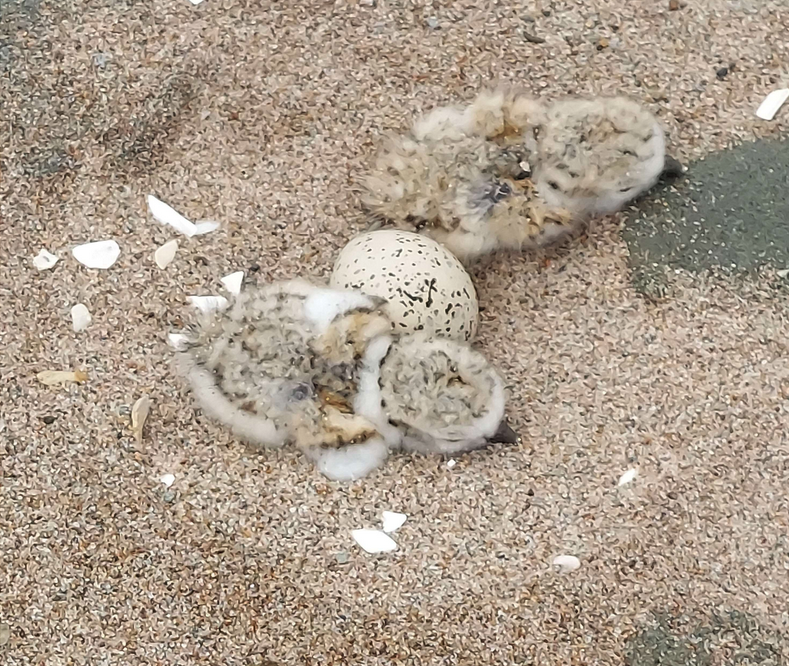
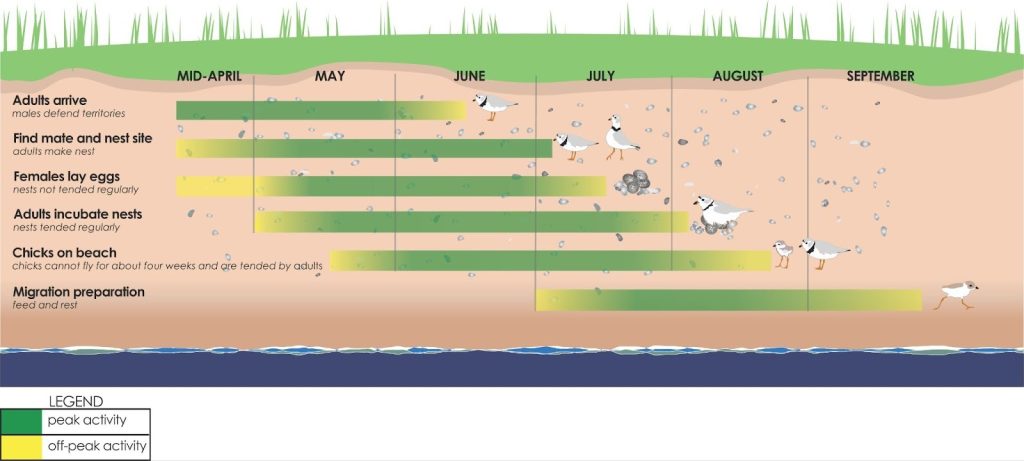
The Piping Plover (Charadrius melodus melodus) is a small, migratory shorebird that breeds on the coastal beaches of Eastern Canada between April and August. Eggs are laid and young are raised on the open beach between the ocean and dunes. They forage along the shoreline and in shallow waters, feeding primarily on small invertebrates. Piping Plovers are designated as Endangered in Canada. Piping Plover migrate south to spend the winter in parts of the southern United States, the Caribbean, and South America.
Its breeding range in Canada is largely confined to a few Atlantic shorelines. That is why it is important to protect the plover by sharing our beaches with these birds.
How can I help Piping Plover?
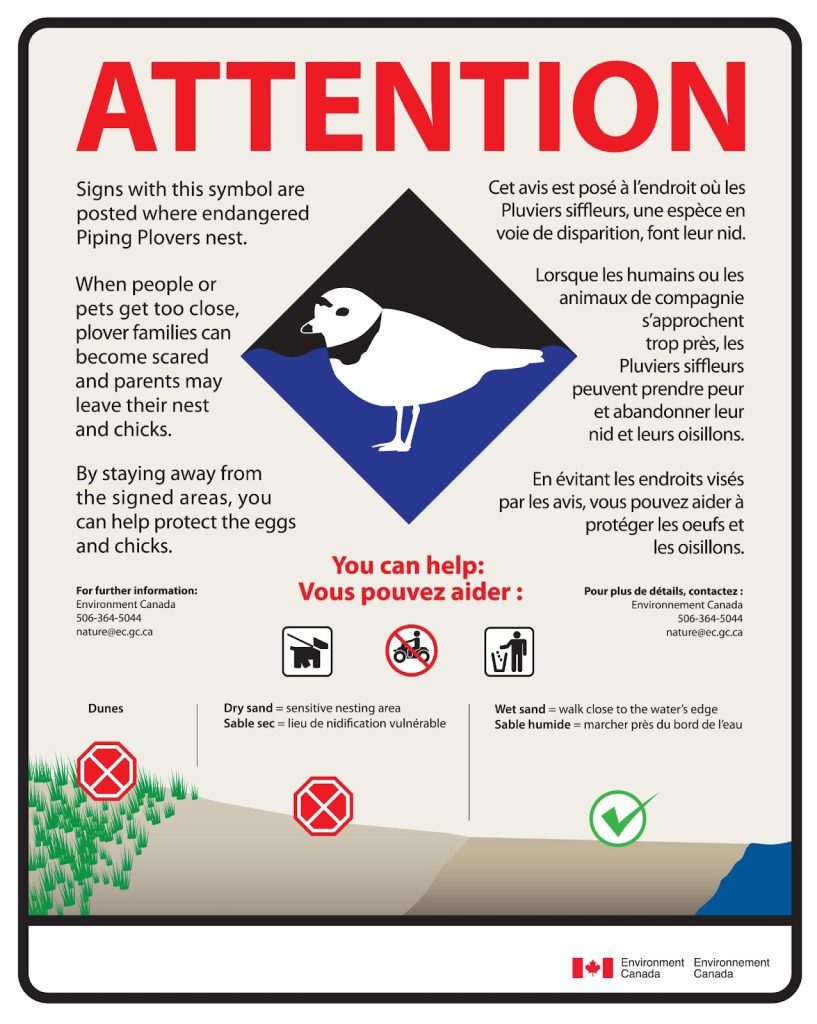
- Leave lots of space between you and birds on the beach and view birds from a distance using binoculars, phone camera, camera with zoom lens, etc.
- Keep your pets on leash while walking on beaches during nesting season
- Do not operate vehicles on beaches or adjacent habitats
- Take any garbage with you from the beach
- Follow the advice of any signage at your local beaches
- Walk close to the waters edge and stick on the ‘wet sand’
- Educate your friends and family, volunteer with us
How can I identify a Piping Plover and distinguish them from other shorebirds?
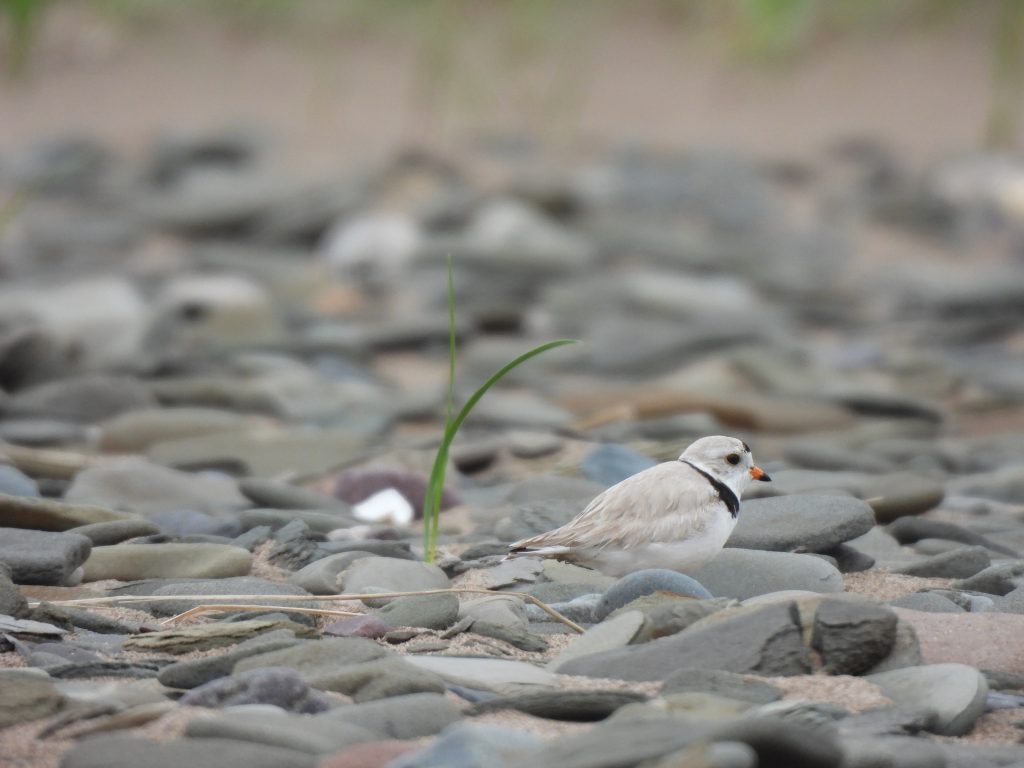
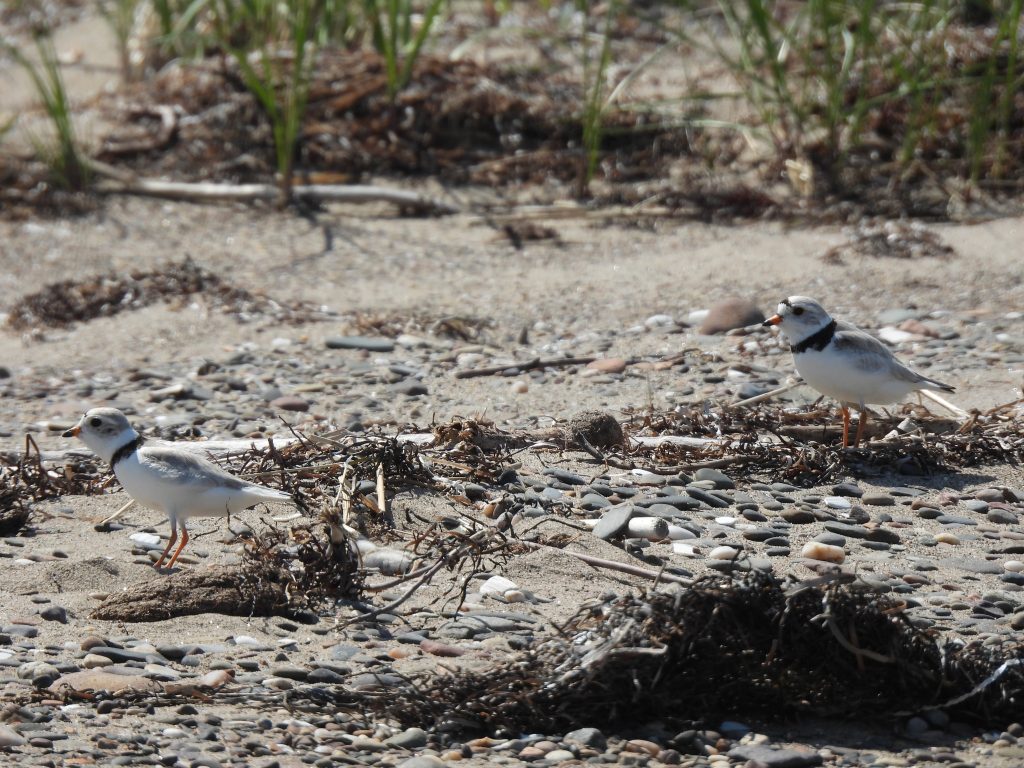
Piping Plover are sandy grayish brown birds with white underparts and a narrow, dark interrupted collar around the neck. They have yellowish orange legs in all seasons. In the breeding season, they have an orange bill with a black tip, a black collar, and a black line on the forehead. In the nonbreeding season, the bill is black and the collar fades to gray and doesn't go all the way around the breast.
Acknowledgements
Thank you to the New Brunswick Environmental Trust Fund for supporting this work and a special thanks to Birds Canada and Panchroma for data refinement, coordination, and web development efforts.
Photos for report cards can be attributed to Lewnanny Richardson, Maxwell (mafr), and Sebastien Benoit.